Bangladesh, a Muslim majority south Asian nation of over 170 million people, remains in the media mostly for wrong reasons. The country, bordering India and Myanmar, is known for street-demonstrations almost every week in its capital city of Dhaka and also regular pronouncement of capital punishment to convicts where many are subjected to execution very often. The latest series of death penalties surfaced on 15 September 2026, where seven Bangladesh Awami League acquaintances were handed the highest punishment for their crime against humanity during the July-August mass agitation two years back across the country.
Former Bangladesh premier Sheikh Hasina, ousted after the same mass uprising and currently taking an unofficial shelter in India, faced a similar verdict in November 2025. The International Crimes Tribunal (ICT, there is nothing international in it as all judges are Bangladeshi nationals and its jurisdiction confined to Bangladesh only) convicted Hasina (chief of Awami League) and her home minister Asaduzzaman Khan Kamal for the crackdown on the agitators. According to a panel endorsed by the United Nations, over 1,400 people were killed and 25,000 injured (including many youths) during the nationwide movement in 2024.
Now the same ICT has awarded capital punishment to Awami League general secretary Obaidul Quader along with Bahauddin Nasim, Mohammad Ali Arafat, Sheikh Fazle Shams Parash and Mainul Hossain Khan Nikhil. Two Chhatra League (affiliated to Awami League) leaders Saddam Hossain and Sheikh Wali Asif Enan were also convicted for orchestrating mass killings during the youth-led uprising. The Dhaka-based three-member ICT panel also ordered the seizure of 50% personal properties belonging to Quader, Nasim, Arafat, Parash and Nikhil. The confiscated (cumulative Taka 500 million) wealth is expected to be utilized for compensation to the families which suffered in the demonstration.
Death Penalty in Absentia
Amazingly all the death-row convicts were tried in absentia as they remain fugitives and a large section of Bangladeshi nationals believe that they are secretly taking shelter in India. The traumatized families welcomed the verdict and urged the Tarique Rahman led Bangladesh Nationalist Party (BNP) government in Dhaka to bring back all of the convicts for their execution. The victim-family members still remember how a student-led anti-Hasina movement engulfed the whole country and even after using violent crackdowns, the government could not survive. Even after ruling the country for a consecutive 15 years, Hasina was overthrown and she was compelled to flee on 5 August 2024 to take a temporary shelter in New Delhi.
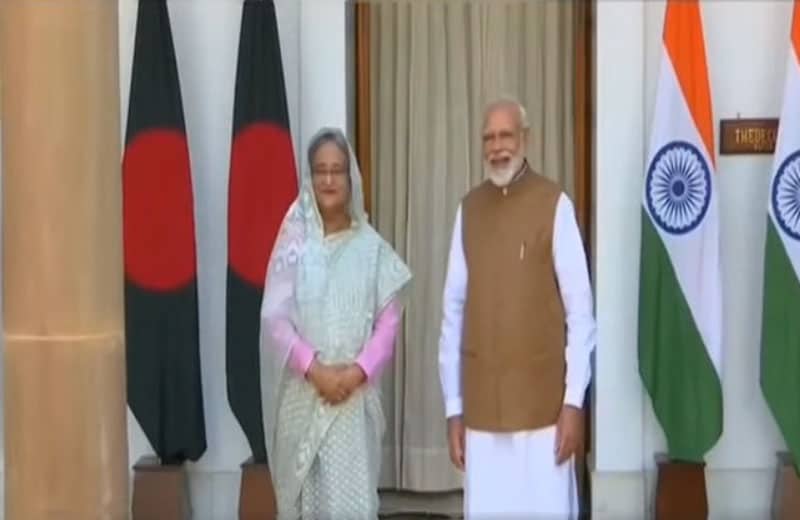
The interim government of Bangladesh led by Nobel laureate Professor Muhammad Yunus started the mission to bring back Hasina for trials in Dhaka, but New Delhi always gave a lukewarm response. BNP chief Rahman, who was elevated as the premier after 13th national polls held on 12 February this year, continued the cry for her extradition under a 2013 extradition treaty between the two neighbouring countries. Dhaka used different channels to insist on Hasina’s repatriation, but New Delhi lately stated that it was examining the matter under the context of relevant laws. Unconfirmed sources claim that New Delhi put some conditions over Hasina’s extradition, primarily asking for her security and also fair trials in Bangladesh.
The situation turned more complex, when the 78 years old Hasina recently declared that she would return to Bangladesh by the coming December. The brave daughter of Bangabandhu Sheikh Muibur Rahman, while addressing an audio-live press briefing in New Delhi on 5 August last, vowed her determination to return back to her country. Hasina’s intention to return voluntarily to Bangladesh received a huge space in global media outlets, even though the Bangladeshi media faced restriction in covering (or highlighting) the event.
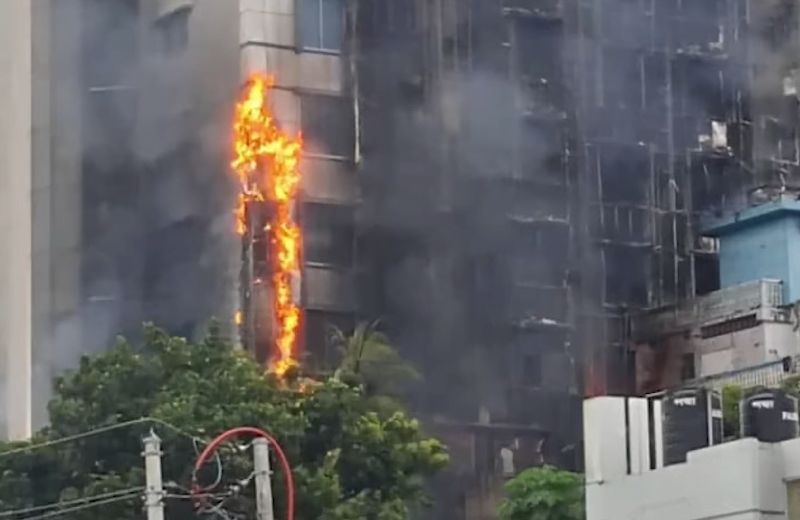
Bangladesh hotel burns after Sheikh Hasina exit. image from video screenshot.
The annoyed Rahman government expressed dissatisfaction that ‘a genocider’ was allowed to interact with the media by the Indian authorities. Dhaka administration officials claimed that Hasina must not be allowed to return on her own but she be repatriated. They also indicated that once she arrives on Bangladesh soil, Hasina will be executed as she has already lost the opportunity to appeal against the following 30 days deadline that has already expired after the ICT verdict. In fact, they want to capture Hasina and compel her to face legal processes in Bangladesh. The Hasina factor seemingly prevented Rahman from taking up his first official overseas visit not to India, but Malaysia and China.
New Delhi promptly responded to Dhaka’s anger, clarifying that Hasina’s event was organized by an independent press club with no role from local authorities. Asserting that it does not endorse any view expressed in the briefing, an Indian foreign ministry spokesperson reiterated that Hasina and her party workers are restricted in engaging with any political activities in India targeting a sovereign nation. Even though India is not a signatory to the UN 1951 Refugee Convention and 1967 Protocol, where refugees are entitled to receive some basic rights, New Delhi remains conscious about its global image that has been preventing it from sending Hasina in a hurried way.
No Mercy
There was also an unusual hope for Hasina, where Md Sahabuddin was the President of Bangladesh as he was one of the trusted Awami League leaders. But lately BNP stalwart Mirza Fakhrul Islam Alamgir becomes the President of Bangladesh (following the 20 August polls in Jatiya Sansad). A faithful ally to Rahman’s mother Khaleda Zia, Fakhrul Islam personally faced humiliations from Hasina’s regime on various occasions. Hence no mercy can be expected from President Fakhrul Islam once Hasina arrives in Bangladesh voluntarily or by any other means.
BRICS
Rahman, though invited to the 18th BRICS outreach session in New Delhi on 12-13 September last, as the current chair of BIMSTEC (Bay of Bengal Initiative for Multi-Sectoral Technical and Economic Cooperation), did not attend probably because of Hasina’s presence in India. Political observers believe it was a lost opportunity for Bangladesh and Rahman in particular, because his participation would have helped the country to highlight many relevant issues and also easing bilateral ties with New Delhi. But the Hasina factor has somehow compelled Rahman to avoid the India trip, as millions of aggrieved Bangladeshi nationals are awaiting execution of the ousted premier and other autocratic leaders, who were already convicted for deaths by their court.