The third edition of the Pragjyotishpur Literature Festival 2025 wrapped up on 16 November at Srimanta Sankardeva Kalakshetra in Guwahati, closing three days of concentrated focus on Assam’s literary heritage and its future readers.
Festival president Phanindra Kumar Dev Choudhury, chief guest and Sahitya Akademi awardee Dr Apurba Kumar Saikia, along with a hall full of authors, critics, journalists and readers, joined the valedictory session. The festival opened on 14 November with a clear mission: to reconnect younger Assamese generations with the region’s long literary tradition and cultural memory.
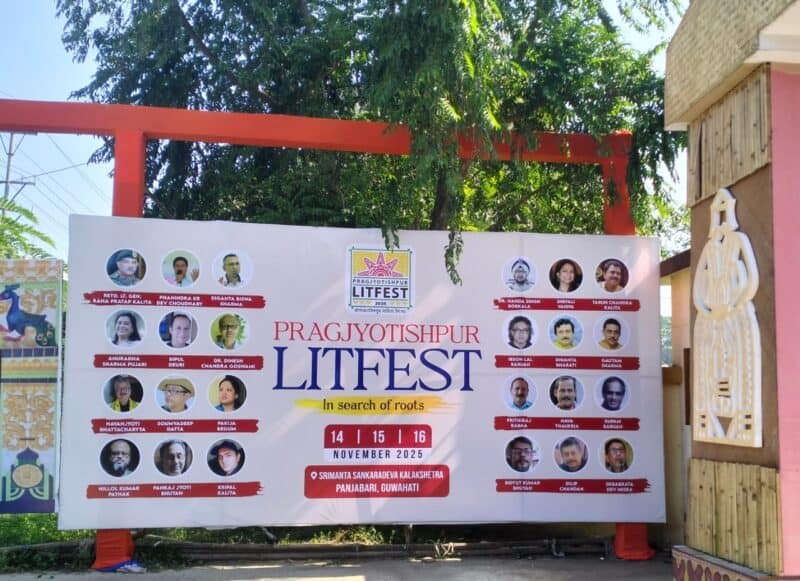
Pragjyotishpur Literature Festival 2025 banner
Pragjyotishpur Literature Festival 2025 Awards
This year’s Pragjyotishpur Literature Festival awards went to Tiwa scholar and essayist Maneswar Dewri and emerging short story writer Srotaswini (Srotashwini) Tamuli.
Dewri, known for long-standing work on Tiwa society, literature, culture and history, said the recognition deeply moved him. He spoke about his decades of research into the Tiwa community’s identity and the hurdles that work encountered. Many of his books document events in western Assam, material he believes will support future researchers and historians when they write more complete histories of the State.
Srotaswini, author of the Assamese story collection Jalkhar and a research scholar at Birangana Sati Sadhani State University, said the award early in her career increased her sense of responsibility to sustain serious creative writing in the years ahead.
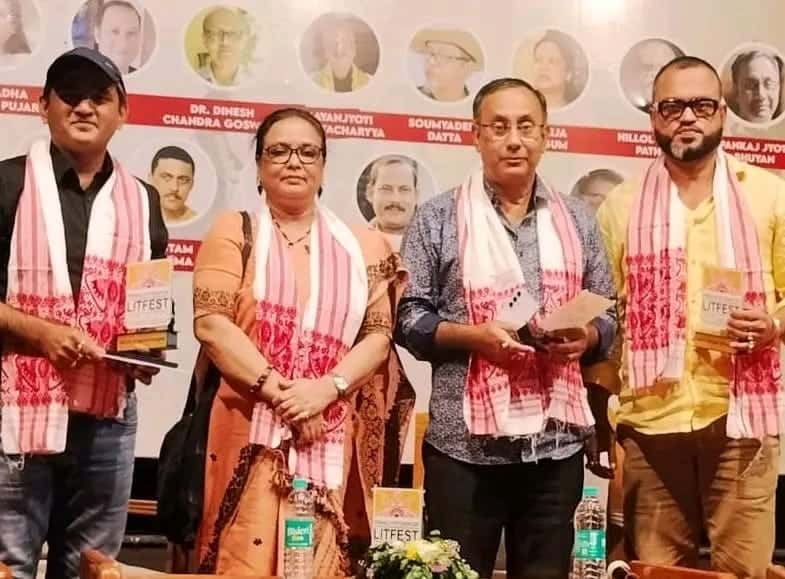
Litfest awards
In his address at the closing session, Dr Saikia praised the three-day programme built around the theme “In Search of Roots.” He said the sessions presented the history, culture and languages of the region once known as Pragjyotishpur, later the Kamrup kingdom, in a meaningful way for today’s audience.
Enthusiasm Welcomed
He welcomed the enthusiasm among young writers, translators, journalists, theatre and film workers, and general readers who attended the sessions. Dr Saikia expressed hope that the Pragjyotishpur Literature Festival would soon stand among the important literary festivals in India.
An earlier session titled “The Creative World of Novelist Birendra Kumar Bhattacharya: An Exploratory Journey” revisited the work of the Jnanpith award-winning Assamese novelist. Anuradha Sarma Pujari, Pranjal Sharma Basishtha, Smritirekha Bhuyan and media columnist Rupam Barua discussed Bhattacharya’s fiction and its lasting place in Indian literature.
One of the notable events focused on nature literature, led by conservationist writer Soumyadeep Dutta. The wildlife activist explained how writing about nature can influence social attitudes and help shape a more sensitive society.
Dutta, who draws inspiration from the teachings of Gautam Buddha, contrasted western “green” writing, which he described as largely human-centric, with the nature literature of Bharat, which regards all living beings as part of a shared world.
A separate session examined the growth of Assamese translated literature. Sahitya Akademi translation awardees Bipul Deuri and Diganta Biswa Sarma, along with writer–translator Dr Nayanjyoti Sharma, took part in a discussion on “Transcending Language Boundaries: The Triumphant Journey of Assamese Translated Literature.”
Biswa Sarma, recognised as a scholar of the Indian knowledge system, noted that faithful translations now earn respect as original literary works in their own right. He stressed that Sanskrit, though rarely spoken in daily life, still plays a vital role in nourishing India’s regional languages and must remain alive for future generations.
Nayanjyoti pointed out the obstacles and opportunities in translating from Assamese into other languages and back, indicating that the field continues to open new paths for writers and readers.
Pragjyotishpur Literature Festival 2025
Three-Day Festival Opening
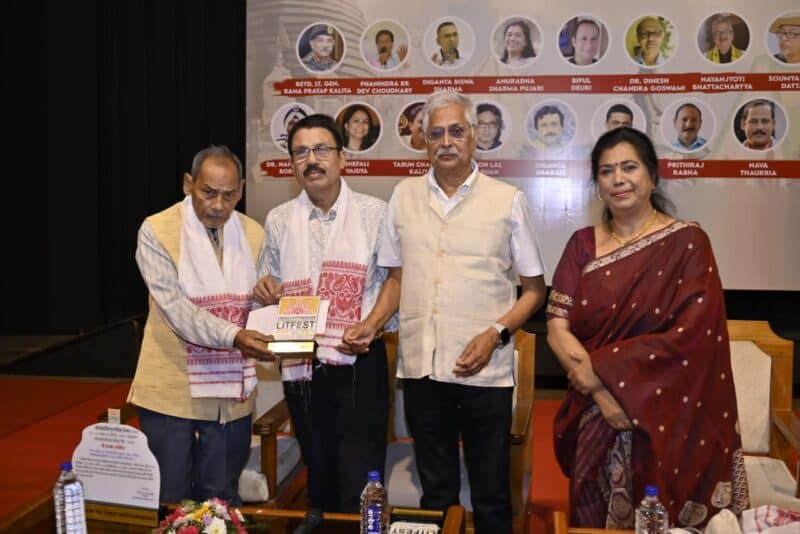
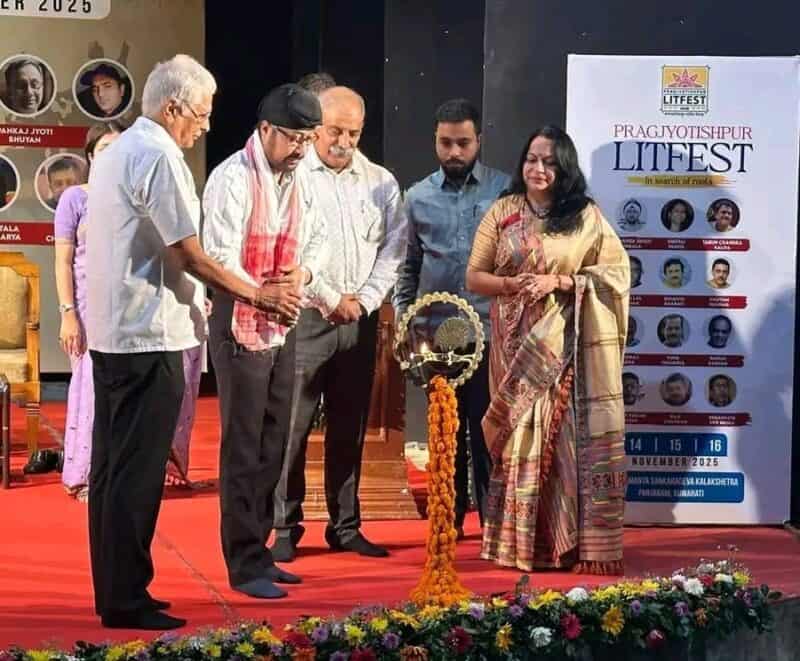
Distinguished writer Nanda Singh Barkola opened the three-day festival. He spoke about India’s growing global profile while evoking the depth of its cultural inheritance. Linking his remarks to the festival theme, Barkola, a senior police officer by profession, referred to Dr Bhupen Hazarika’s song “Karbi Anglong Oti Numoliya …” and urged a renewed engagement with pre-Sankari traditions to rediscover forgotten literary roots.
Internationally known author Shefali Vaidya delivered the keynote address. She welcomed the festival’s attempt to draw younger generations back to their cultural and intellectual heritage. Beginning her speech in Asomiya, she also cited Bhupen Hazarika’s songs to underline the linguistic and cultural richness of Assam and the wider North East.
Organising committee chairman Lt Gen (Retd) Rana Pratap Kalita of the Sankardeva Education and Research Foundation and Pragjyotishpur University vice-chancellor Smriti Kumar Sinha joined the inaugural programme.
Pragjyotishpur Literature Festival 2025
The day featured the release of a souvenir titled Pragjyoti, edited by Hemchandra Doley. Participants also offered floral tributes to three cultural figures of Assam: singer–composer Sudhakantha Dr Bhupen Hazarika, musician Pranar Shilpi Zubeen Garg and flute maestro Deepak Sharma.
The second day featured four sessions, including a well-attended interaction with actor, legislator and playwright Prithwiraj Rabha. He spoke about the life and struggles of his father, Kalaguru Bishnu Prasad Rabha, widely regarded as a towering cultural figure in Assam.
In a session moderated by technocrat writer Nayanjyoti Bhattacharyya, Prithwiraj Rabha outlined his father’s journey from a brilliant student to a noted artist and revolutionary figure. He said Kalaguru dedicated his life to three masters — Sri Krishna, Srimanta Sankardeva and Leonardo da Vinci — and illustrated that claim with incidents drawn from his personal and artistic life.
A panel on “Assamese Language, Literature and Journalism: Growth and Expansion” attracted many young media professionals. Senior journalists Dilip Chandan, Bedabrata Dev Mishra, Nava Thakuria and Bidyut Kumar Bhuyan shared the platform.
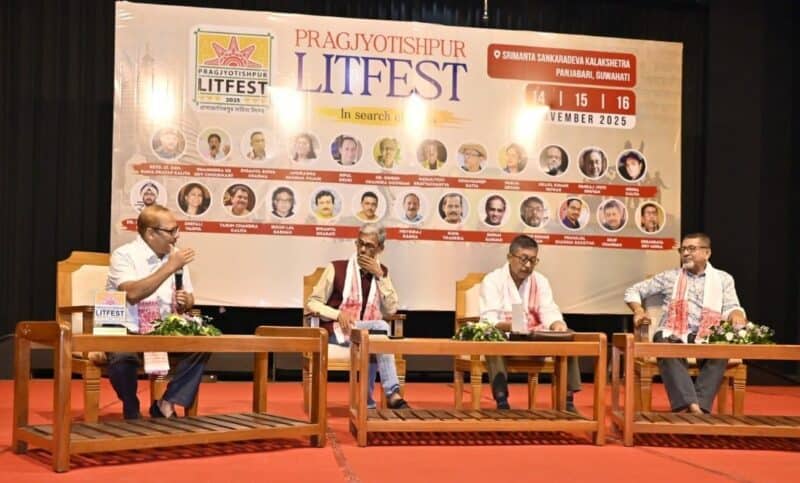
Senior journalists Nava Thakuria, Dilip Chandan, Bedabrata Dev Mishra and Bidyut Kumar Bhuyan shared the platform at litfest 2025
They argued that traditional print journalism can regain readers if it continues to support and strengthen the Assamese language while audiences begin to feel the effects of “digital fatigue” from television and online platforms.
Another session, “Evolution of Assamese Performing Arts: From Ankiya Bhawana to Bhramyman,” focused on theatre and stage traditions. National award-winning filmmaker and playwright Kripal Kalita, performer Pakija Begum, and dramatists Pankaj Jyoti Bhuyan and Hillal Kumar Pathak took part in the discussion.
The panellists described theatre as the “mother” of all performing arts. They acknowledged the contributions of Assam’s mobile theatre companies and outlined the difficulties the sector faces. At the same time, they said the field still offers significant promise, even though Assamese theatre has yet to define a clearly recognised school of its own.
The festival’s first panel, “Transformation and Evolution of Assamese Lyric Literature: From the Nineties to Present Era,” examined changes in song and lyric writing. Lyricist–composer Gautam Sharma moderated the discussion, with Tarun Kalita, Diganta Bharati and Ibason Lal Baruah sharing their views. They expressed cautious optimism about the prospects of the Assamese language, backed by energetic literary production.
Two multilingual poetry sessions titled Kavya Kaveri brought together a group of popular poets. They read their own work in various languages and kept audiences engaged with a mix of styles and voices.
On behalf of the organisers, PLF general secretary Bikram Kalita and team members Kishor Shivam, Hirakjyoti Sarma, Pramod Kalita and Bhaskarjyoti Sarma thanked participants and guests. They noted that authors, translators, critics, performers and literature lovers created a genuinely collaborative atmosphere during the Pragjyotishpur Literature Festival 2025, reinforcing its aim to root a modern festival in Assam’s deep cultural soil.
See Also: Pragjyotishpur Literature Festival2024 Concludes on a High Note
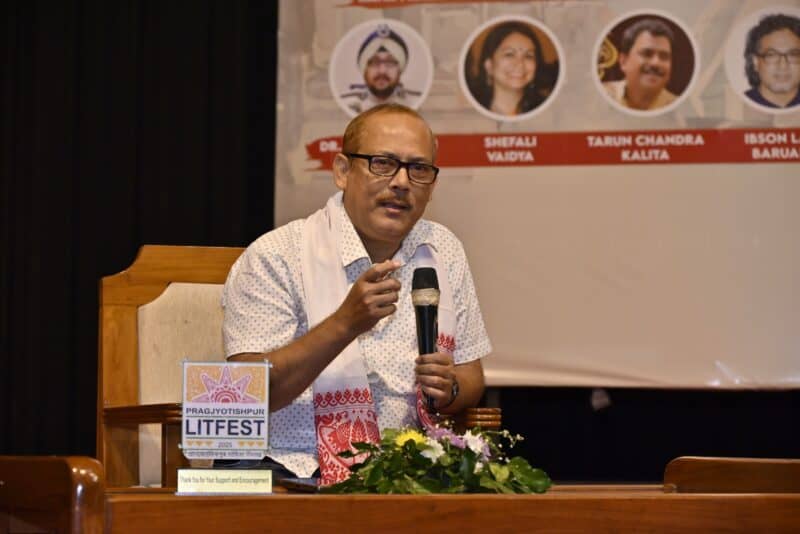
Nava Thakuria at litfest